There are evenings at the Royal Opera House when one is reminded, with rare clarity, of opera’s unique capacity to illuminate the human condition. This revival of La traviata is such an occasion: a production of poise and emotional intelligence that feels as vital now as it must have on its first unveiling. Verdi’s most intimate tragedy, so often reduced to familiar gestures, here unfolds with freshness, restraint and devastating sincerity.
Richard Eyre’s much-loved staging, now in its fourth decade, remains a masterclass in narrative fluency. Eschewing directorial grandstanding, it allows the drama to breathe, trusting Verdi’s score and Francesco Maria Piave’s libretto to do their work. The result is a production that feels both classically proportioned and psychologically alert, attentive to the fragile interior lives of its characters without ever labouring the point.
In the pit, Antonello Manacorda conducts with a finely judged balance of tension and lyricism. From the hushed prelude — those aching, suspended phrases that seem already to mourn what is to come — the orchestra plays with translucence and care. Manacorda resists sentimentality, favouring clarity of line and rhythmic elasticity, allowing Verdi’s melodic invention to speak with natural eloquence. The Royal Opera House orchestra responds in kind, offering a performance of polish and expressive depth.
At the centre of the evening stands Ermonela Jaho’s Violetta, a portrayal of exceptional psychological acuity. Jaho’s soprano possesses a distinctive intensity: not conventionally opulent, but richly expressive, capable of colouring a phrase with a glance or a breath. From her first appearance, this Violetta is keenly alive to her own contradictions — glittering in company, yet already haunted by self-awareness.
In ‘Ah, fors’è lui’, Jaho shapes the music with introspective tenderness, her phrasing suggesting the shock of genuine feeling breaking through a cultivated façade. The ensuing ‘Sempre libera’ is not merely a display of vocal agility, but a portrait of defiance tinged with unease — a woman asserting her freedom even as she senses its fragility. It is this emotional layering that makes Jaho’s performance so compelling: every vocal choice feels tethered to character.
As the drama darkens, her Violetta deepens rather than diminishes. The second act brings moments of quiet devastation, particularly in her confrontation with Giorgio Germont, where dignity and vulnerability coexist in painful equilibrium. By the final act, Jaho pares everything back. Her physical stillness, the fragility of her sound, and the devastating simplicity of her final utterances create a closing scene of profound intimacy. It is a performance that lingers in the mind long after the curtain falls.
Opposite her, Giovanni Sala offers an Alfredo of warmth and emotional directness. His tenor is open-hearted and ardent, well suited to Alfredo’s impulsive nature, while his dramatic arc — from infatuated youth to chastened lover — is convincingly traced. Sala avoids caricature, presenting Alfredo as flawed yet sincere, his cruelty born of immaturity rather than malice.
Aleksei Isaev’s Giorgio Germont is similarly thoughtful. His authority is quietly asserted, his moral certainty tempered by moments of genuine doubt. In ‘Di Provenza’, Isaev resists overt sentiment, allowing the aria’s paternal melancholy to emerge with understated grace. It is a portrayal that honours Germont’s complexity, acknowledging both his social rigidity and his capacity for remorse.
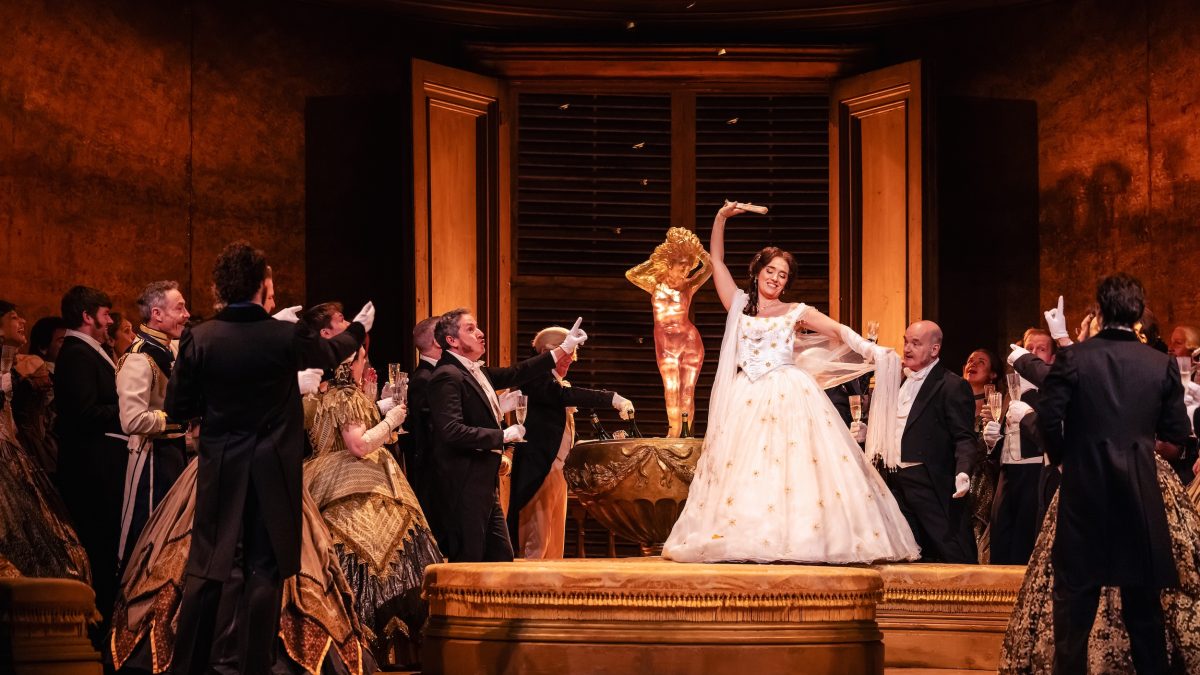
Visually, Bob Crowley’s designs continue to serve the production beautifully. The curved set, reconfigured across the acts, creates a sense of continuity while subtly shifting emotional emphasis. Its surfaces and proportions strike a careful balance between elegance and theatrical clarity, offering a sumptuous frame for the drama without ever overwhelming it. Whether evoking the brittle glamour of Parisian society or the exposed vulnerability of Violetta’s final refuge, the design supports the narrative with discretion and intelligence.
The chorus plays a vital role, bringing energy and precision to the social scenes without ever eclipsing the principals. The famous brindisi sparkles with effortless charm, while the later ensemble scenes bristle with underlying tension, reminding us that society in La traviata is both seductive and merciless.
What ultimately distinguishes this revival is its emotional honesty. There is no attempt to reinvent La traviata for novelty’s sake; instead, it is presented with confidence in its enduring relevance. Themes of love, sacrifice, hypocrisy and compassion are allowed to unfold organically, their resonance amplified by performances of rare sensitivity.
In an operatic landscape often dominated by conceptual excess, this La traviata stands as a reminder that refinement, intelligence and emotional truth remain the most powerful tools of all. At Covent Garden, Verdi’s tragic heroine is given space to live, to love and to die with dignity — and in doing so, the Royal Opera House delivers an evening of opera at its most quietly magnificent.
Royal Opera House, Bow Street, London WC2E 9DD, until 17 February 2026